I'm not a big fan of racing movies. About a year ago, when F1: The Movie came out, a friend told me how the story pulls you in even if you don’t care about racing, so I went. I wasn’t expecting to think about my job afterward, but I walked out with one scene stuck in my head.
It was the pit stop. The crew took seven seconds. It should have taken half that time. The driver was furious. The crew knew exactly where things had gone wrong. Nobody said much, because everyone understood what those extra seconds had cost. The race was decided in a lane, not on the track.
That scene stayed with me.
Twenty people, perfectly synchronized, every motion rehearsed a thousand times, and the window they get is a couple of seconds to get it right, every freaking time. The work is enormous. The time allowed is almost nothing.
And I realized that's what great customer service increasingly feels like.
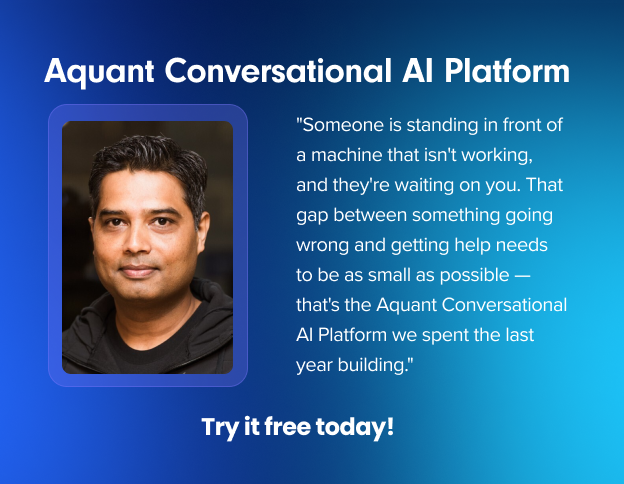
Someone is standing in front of a machine that isn't working, and they’re waiting on you. In that moment, they don't see the work happening behind the scenes. They just experience the gap between something going wrong and getting help. And that gap needs to be as small as possible.
Behind it, everything has to happen at once. Hear what they said. See what they're seeing. Remember what they told you two minutes ago. Anticipate where this is going. And search millions of manuals, schematics, diagrams, troubleshooting flows, CRM records, and service histories.
That's the Aquant Conversational AI Platform we spent the last year building.
Here's what made this hard. We didn't build this for insurance companies or banks. We built it for people who make physical things. And physical things fail in ways software never does.
It doesn't matter how simple the product looks. A router, a vending machine, a dialysis device. The number of ways any of them can go wrong is effectively infinite, and it grows every time we make them smarter.
And the knowledge to fix them is scattered everywhere. Some of it is in manuals. Some are in a ticketing system nobody searches. And a lot of it lives in the head of one technician who's been doing this for thirty years.
Getting that knowledge usable is its own problem. Manuals as PDFs. Service records in spreadsheets. Schematics and exploded diagrams that are images, not text. None of it speaks the same language. So we built the pipeline that pulls all of it in, reads it, connects it, and turns it into something an agent can actually reason over in the middle of a conversation.
Then meet people where they already are. Some want to talk. Some want to text. Some want the web. And sometimes the fastest thing is just showing the agent, because describing a noise or a leak or a blinking light is harder than pointing a camera at it. Voice, SMS, web, and vision. Same agent, same knowledge, whichever way someone reaches for it.
But building the agent is the easy part. What happens after you deploy it is the real work. So we also built it for the people running these agents, not just the people calling them. Service managers can watch conversations as they happen, step in, take over when it matters. Administrators can review what worked, what didn't, and change the agent that same day.
And every conversation teaches us something. What the caller was frustrated by. What the agent couldn't answer. What should have been in the knowledge base and wasn't. That goes back into the system, so the agent that answers tomorrow is better than the one that answered today.
And you don't need one agent that tries to be everything. A technician diagnosing a fault code and a customer with a simple question are different conversations. So you build the agent for the job. Two agents, two numbers, two personalities, whatever the work actually needs.
Here's the part I still find a little unreasonable. You can build one in about five minutes (checkout our tutorials). Not a prototype. A real agent, on a real number, that you can call.
We're opening up Aquant Conversational AI for a free trial. Start here. Build something. Point it at your own data. Call it and try to trip it up. And then tell me what you found, because that's how this gets better.
Questions, feedback, or just want to compare notes? Reach me at indresh.ms@aquant.ai - I read everything.