Not every call that comes in needs a trained technician. A lot of it is basic information-gathering — serial numbers, model numbers, what's actually wrong — that eats up time before real troubleshooting even starts. Service leaders we talked to had already landed on the same fix independently: let AI handle intake first, and only bring in a person when the issue actually needs one.
What we're hearing
"The process would be that it goes to an AI agent first — the AI agent can be gathering things like the serial number — and then if more information is needed, it would go to an actual person. That's probably where we'd want to start with the AI." — Technical Support Supervisor, medical device company
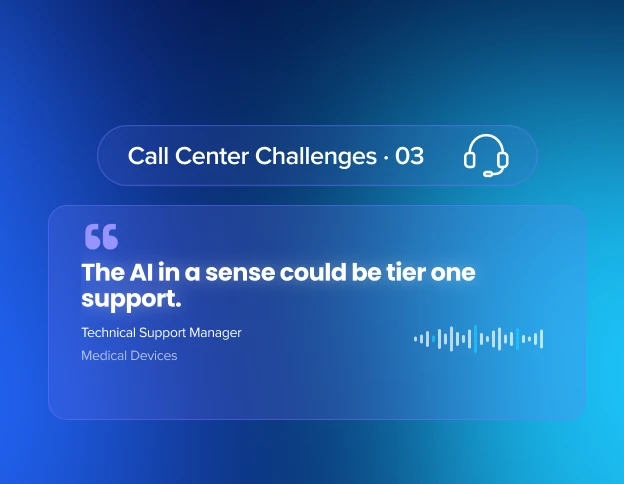
"Within my team it would be the customer would call in, the AI would do the intake... if it was a simple issue, they could solve the customer's issue without even having to be deployed to a rep... the reps will be the tier two and tier three support. The AI in a sense could be tier one support." — Technical Support Manager, medical device company
Where AI helps
Think of it as a smarter front door, not a replacement for your team. AI collects what it can before a human ever picks up, redirects simple or misrouted calls on its own, and only escalates when the issue is genuinely complex — handing the rep full context instead of a blank slate. Reps spend their time solving problems instead of filling in intake forms.
Learn more about conversational AI or book time with Aquant.