Aquant vs. ChatGPT
.svg)

ChatGPT is powerful, but not built for service
Aquant delivers agentic AI built specifically for service, so value shows up fast, and scales without the usual overhead.

General intelligence ≠ service intelligence
ChatGPT can answer almost anything, but it doesn’t inherently understand your equipment, failure modes, parts relationships, entitlements, or workflows. Aquant is designed around how OEMs and service organizations operate.

More work to operationalize at scale
To use ChatGPT reliably across service, you typically need governance, permissions, curated knowledge, and ongoing tuning, plus integration work so it can access the right data. Aquant is purpose-built to deploy in service environments with structure and support.

Not offline-first for the field
Get pre-built agents for common service use cases, plus a low-code builder that plugs into any CRM. And with features like Voice AI and Offline Mode, Aquant is built to work where your techs are at, so they can start seeing value immediately.

Not KPI-driven by default
ChatGPT can be prompted to prioritize outcomes, but it won’t naturally optimize for service KPIs like first-time fix or MTTR without customization and validation. Aquant is KPI-driven by design, so recommendations are tuned to measurable service outcomes.

Deep Domain Intelligence
A service-specialized Autonomous Linguistics Engine trained on millions of real service tickets, error codes, schematics, and IoT signals.

Human-in-the-Loop Automation
Precise insights, action plans, and recommendations that amplify human judgment, never blind autonomy.
Rapid Time to Value
Pre-built, field-tested agents that get you running in weeks, not months, with no heavy ontology work or custom model training.

Reduced Risk & Lock-In
A standalone SaaS platform that integrates seamlessly with any CRM or ERP, no Salesforce licenses required.
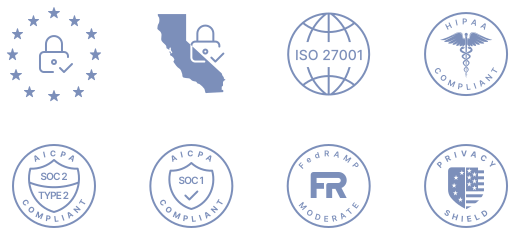
The highest trust and security standards
FAQ
The agentic AI platform built for your entire service team
Absolutely! Roger (Aquant's voice AI) is capable of triggering multiple tasks simultaneously. For example, it can interact with agents built within Aquant’s Agent Studio, third-party agents, or even various third-party MCP tools. It can also connect to a wide range of backend systems through Aquant’s connectivity platform. This means the agent can not only read information from these systems but also modify it as needed. In other words, it’s fully equipped to handle multiple workflows at once, making it really flexible for your needs.
Yes, absolutely! There are a couple of ways to handle authentication. One method is using Roger (Aquant's voice AI) directory of authorized callers, where Roger checks incoming calls against that list and rejects unauthorized ones with a customizable message. Additionally, Roger can also integrate with external identity providers to verify if a caller is authorized. This means it can reach out to these external systems to confirm caller identity before letting them through. All of this is configurable and the caller info can be passed along to downstream CRM tools if you have those set up. This should help ensure only the right callers get through!
Absolutely. Aquant is multimodal in several important ways. Users can interact with it using text, voice, files, and images. Aquant can ingest and reason over complex enterprise content like service manuals, logs, spreadsheets, schematics, tables, images, videos, and even handwritten notes embedded in documents. Outputs are generated by reasoning across all of that content, not just text. And beyond UI-based interaction, Aquant also supports voice AI via phone calls, which adds an entirely new interaction modality for service use cases. So we are multimodal at the input layer, content layer, and interaction layer.
Yes. Aquant can accelerate onboarding with a dedicated Training Agent that supports technicians before and during live jobs. It can:
- Walk new techs through common procedures and troubleshooting flows
- Provide scenario-based practice (symptom → diagnosis → resolution) using real historical cases
- Quiz for understanding and reinforce best practices
- Recommend learning paths based on gaps (e.g., error codes, parts handling, safety steps)
This helps standardize how techs learn and reduces reliance on a small number of senior experts.